The Cranial Clinic Growth Weekly
This week in 60 seconds
- The FTC and Google both now ban paid reviews — even “honest” ones. “We don’t tell them what to say” is not a defense. Featured story below, with the real penalty numbers.
- Payers keep tightening medical-necessity language. The clinic’s winning appeals document failed conservative therapy and functional risk, not aesthetics.
- The Medicare DMEPOS moratorium is a growth constraint, not a patient-access cliff. It blocks new suppliers from enrolling, not patients from being treated by existing ones.
- Evidence-based skepticism has reached the parents. The 2014 BMJ trial is now quoted in parenting subreddits — a gift to clinics that lead with PT-first honesty.
- The viral parent story of the season is still the “twins in helmets 23 hours a day” coverage — a lesson in how normalized content spreads.
Featured
The $10 Gift Card Trap
Why paying for reviews is illegal — even when you never tell people what to say
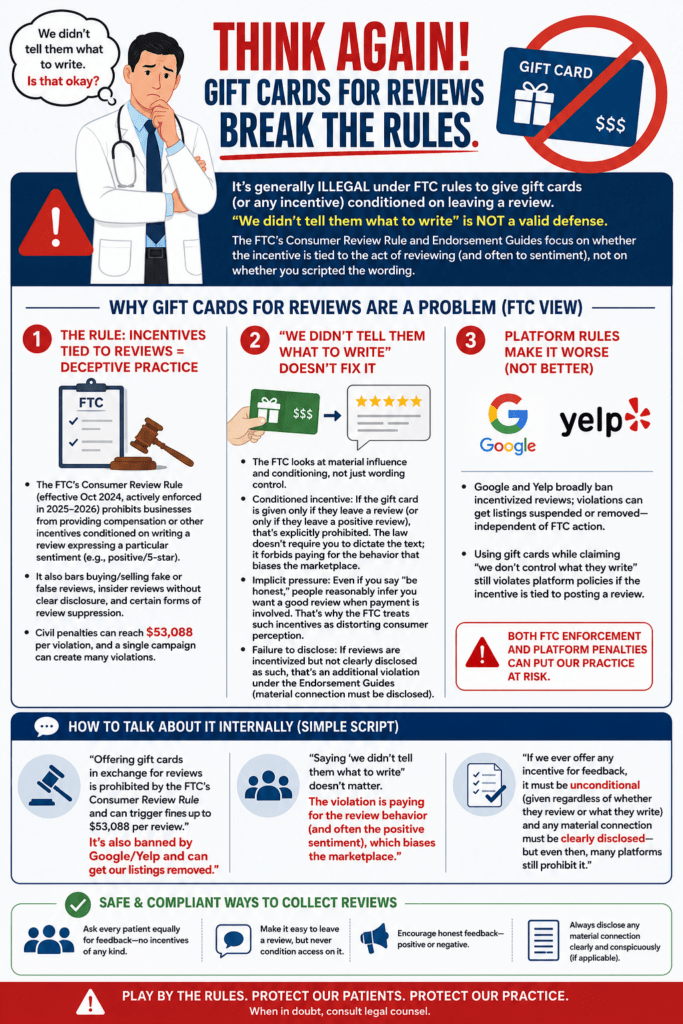
Here’s a scenario we keep seeing in the O&P and wider healthcare space. A clinic hands new families a card: “Leave us a Google review and we’ll send you a $10 gift card.” The reviewer has to post before they get the card. The clinic never dictates the wording. Staff genuinely believe they’re in the clear because “we didn’t tell them what to write, and we only asked for honest feedback.”
They are not in the clear. Under the rules that took effect in 2024–2025, this practice is exposed on two separate fronts.
1. The FTC now has a rule with real teeth
In August 2024, the FTC finalized the Rule on the Use of Consumer Reviews and Testimonials (16 CFR Part 465), effective October 21, 2024. Two provisions matter here:
- You cannot condition an incentive on a particular sentiment — positive or negative. If the reward is tied (even by implication) to a favorable review, that’s a per se violation.
- Incentivized reviews are only permissible if the review itself discloses the incentive. A gift card review that doesn’t say “I got a gift card for this” constitutes a deceptive, undisclosed material connection.
So “we didn’t tell them what to say” misses the point. The moment money changes hands and the reviewer doesn’t disclose it, the review is deceptive under federal rules — regardless of how honest the reviewer was trying to be.
The 2025 inflation-adjusted figure (it launched at $51,744 in 2024 — verify the current-year amount before quoting it publicly). Critically, each day a violating review stays up can be treated as a separate violation, so exposure compounds fast. The FTC issued its first round of warning letters to 10 companies in December 2025 — it has moved from rule-making to enforcement.
2. Google bans it outright — sentiment doesn’t matter
Separate from the FTC, Google’s Maps User-Generated Content Policy prohibits offering any incentive — money, discounts, free product/service, gift cards, or raffle entries — in exchange for a review, positive or negative. Google files this under “Fake Engagement” / rating manipulation.
The consequences aren’t a fine — they’re worse for a local clinic that lives on Maps visibility:
- Incentivized reviews get removed.
- The Business Profile can be suspended, temporarily or permanently, killing your Map and Search presence.
- Fake-engagement flags can suppress your ranking for months, even after you stop.
And Google is actively hunting for this: it has begun prompting users directly to report whether a business paid for their review. The detection surface is getting wider, not narrower.
“But hundreds of reviews clearly work…”
They do —, and that’s exactly the trap. Consumers trust a profile with hundreds of reviews, which is why the incentive is tempting and why regulators care. But a review base built on gift cards is a liability sitting in public view, timestamped, waiting to be reported by a competitor, a disgruntled parent, or Google’s own prompt. In a referral-and-reputation business like cranial care, one profile suspension can cost more new-start volume than years of gift cards ever bought.
What to do instead (all fully compliant)
- Ask everyone, incentivize no one. You are 100% allowed to request reviews — just never tie anything of value to them. Make the ask routine at the 2-week and graduation appointments.
- Remove friction, not honesty. A QR code on the discharge sheet, a texted direct link, a tablet at the front desk.
- Systematize the moment of delight. Before/after photos at graduation are the natural high point — ask then.
- If you ever run an incentive/campaign, mandate disclosure in the review — and know Google may still remove it.
- Never let an owner, manager, or staffer review your own clinic without disclosing the relationship — the rule specifically targets undisclosed “insider” reviews.
Bottom line: The clinics with unshakeable reputations aren’t buying reviews. They’re engineering a great graduation experience and simply asking — at scale, on autopilot, with zero legal exposure.
Here is a cheat sheet that you can download and give it to your staff. It’s not fair when companies pay for reviews. Help keep everyone playing by the same rules. Report companies that pay for reviews.
The Insurance & Policy Pulse
What clinics are wrestling with in payer-land
Medical necessity is the whole ballgame
Across parent groups and orthotics forums, the recurring pain point is coverage denials driven by “cosmetic vs. medical” framing. Payers are leaning harder on medical-necessity language, evidence reviews, and internal payment policies. The pattern in what actually gets approved:
- Failed conservative therapy first. Repositioning/PT is increasingly required before a helmet gets authorized.
- Numbers, not narratives. Severity indices (CVA, cephalic index) and asymmetry measurements are what establish necessity.
- The letter matters. Physician letters that tie the deformity to functional risk — not appearance — move prior-auth.
The DME moratorium: constraint, not catastrophe
A widely discussed HHS/CMS national moratorium on new DMEPOS supplier enrollments (associated in the threads with Dr. Oz’s CMS) has parents and clinicians anxious. The clarification that keeps getting lost:
- It applies to new suppliers seeking Medicare DMEPOS approval — not to patients getting care from existing suppliers.
- The real impact is structural: it slows new-clinic entry and expansion, especially for rural/niche providers.
- Clinic takeaway: If you’re already enrolled, patient access is intact. If you’re planning to expand or open, factor in friction — consider partnerships with existing DME suppliers and commercial/Medicaid contracts. Verify the moratorium’s current status and scope with CMS before making enrollment decisions.
Families are triaging the cost themselves
With helmets commonly cited in the $1,500–$3,500 range and coverage inconsistent, parents openly compare CareCredit, payment plans, crowdfunding, and charity foundations. The high-engagement posts are the “here’s what we actually paid out of pocket” stories.
Parent Sentiment Watch
How your future customers talk when you’re not in the room
Evidence skepticism has gone mainstream
The 2014 BMJ trial (no significant difference vs. natural course for moderate deformity in healthy infants) is now routinely cited in r/ScienceBasedParenting, r/Parenting, and parenting blogs. A growing share of parents question the use of helmets for mild/moderate cases — especially when insurance won’t pay.
Clinics that transparently align with the evidence — PT and repositioning first, helmets reserved for severe/persistent or synostosis cases — build trust and dodge the “they helmet everything for money” backlash. Skepticism rewards the honest operator.
The normalization wave
On the emotional side, sentiment in helmet-parent groups is supportive but tired — parents want reassurance, routine, and measurable progress more than aesthetic perfection. Viral, share-heavy content tends to normalize helmets: before/after posts, and the familiar “I compare putting my baby in a helmet to a kid wearing braces” framing.
The story of the season: national-outlet coverage of a mom putting twins in helmets ~23 hours a day despite online judgment (People / NY Post, Dec 2025). Cited in the source reports; verify outlet and details before referencing it in your own content. The lesson: parent-generated normalization content travels far — a graduation-photo and progress-story program is your best organic reach.
Three moves for the clinic owner
- Audit your review practice. If anyone on your team is offering anything for a review, stop today and switch to a friction-free “just ask everyone” system.
- Tighten one necessity template. Pick your most-denied payer and upgrade your measurement + necessity-letter package to lead with functional risk.
- Put financing at the front. Add clear, plain-language financing options to your intake conversation and your website’s homepage — before parents go ask the internet.
Sources — Review policy (verified)
- FTC — Rule on the Use of Consumer Reviews and Testimonials (16 CFR Part 465)
- FTC — Consumer Reviews and Testimonials Rule: Questions and Answers
- FTC — Warning letters to 10 companies, December 2025
- Google — Maps User-Generated Content Policy (Prohibited & restricted content)
- PPC Land — Google Maps now asks users if businesses paid for reviews